
Introduction: The Trap of a “Quick Start”
“We have an idea, a budget, and a deadline of ‘yesterday.’ When can you start coding?”
This is the most common question we hear from startups and even established enterprises. The desire to see a finished mobile app as soon as possible is understandable. The market doesn’t wait, and competitors never sleep.
However, in outsourcing development, there is a paradox: the sooner you start coding without a clear plan, the later you will launch the final product.
Imagine building a skyscraper. Would you start pouring the foundation with nothing but a sketch on a napkin? A mobile app in 2026 is a digital skyscraper. Complex architecture, integrations, security, UX/UI—all of this requires engineering.
At VRG Soft, we call this the Discovery Phase. And our experience across dozens of projects proves: investing 4 weeks in Discovery often saves 4 to 6 months of rework (and the associated budget bloat) during the active development stage.
What is the Discovery Phase and Why Does Business Need It?
The Discovery Phase is the preparatory stage before the start of main development. It is the time when we transform an abstract business idea into a clear technical plan and a visual prototype.
Many clients perceive this as “unnecessary bureaucracy.” But let’s look at the risks this stage eliminates:
- The “Expectation Mismatch” Risk. Without Discovery, the development team interprets your idea in their own way. The result can differ drastically from your vision.
- The “Budgetary Black Hole” Risk. Without a detailed spec, it is impossible to give an accurate estimate. “Ballpark” estimates almost always lead to a 50-100% budget increase during the process.
- Technical Dead Ends. Choosing the wrong architecture or tech stack at the start can mean rewriting the app from scratch a year later because it cannot scale.
Discovery is your insurance policy against these risks.
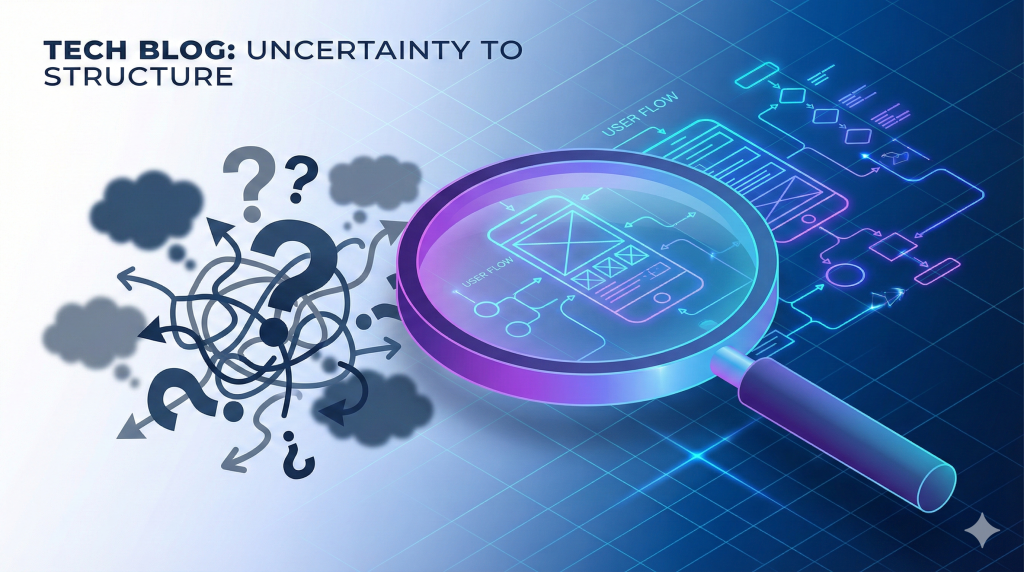
How VRG Soft Conducts the Discovery Phase: Our Process
We don’t just “talk.” We run a structured process that typically lasts from 2 to 4 weeks, depending on the project’s complexity.
Stage 1: Workshops and Business Goals Definition
We gather your key team (Stakeholders) and our experts (Business Analyst, Solution Architect, Lead Designer).
- What we do: We break the idea down into atoms. Who is your audience? What main problem does the app solve? How do you plan to monetize it? Who are the competitors?
- Result: Synchronization of the product vision between the business and the technical team.
Stage 2: User Analysis and UX Prototyping
The app must be convenient for your users, not just for you.
- What we do: We create User Personas and User Journeys. Based on these, designers draw an interactive wireframe prototype (a black-and-white layout without design, but with clickable transitions).
- Result: You can “click through” your future app on a phone before a single line of code is written. This is the best moment to make changes—here, they cost pennies.

Stage 3: Technical Architecture and Stack Selection
This is a task for the Solution Architect and CTO.
- What we do: We solve fundamental questions. Native (Kotlin/Swift) or Cross-platform (Flutter/KMP)? What server architecture is needed for the expected load? Which third-party services (payment gateways, maps, AI) will we integrate? How will we ensure data security?
- Result: A document describing the system architecture.
Stage 4: Roadmap and Final Estimation
When we have a prototype and architecture, we can talk numbers substantively.
- What we do: We break the project into milestones, prioritize features for the MVP (Minimum Viable Product), and provide a detailed estimate of time and budget with an accuracy of ±15-20% (instead of a wild guess).
- Result: A clear action plan and a transparent budget.
What Do You Get as a Result?
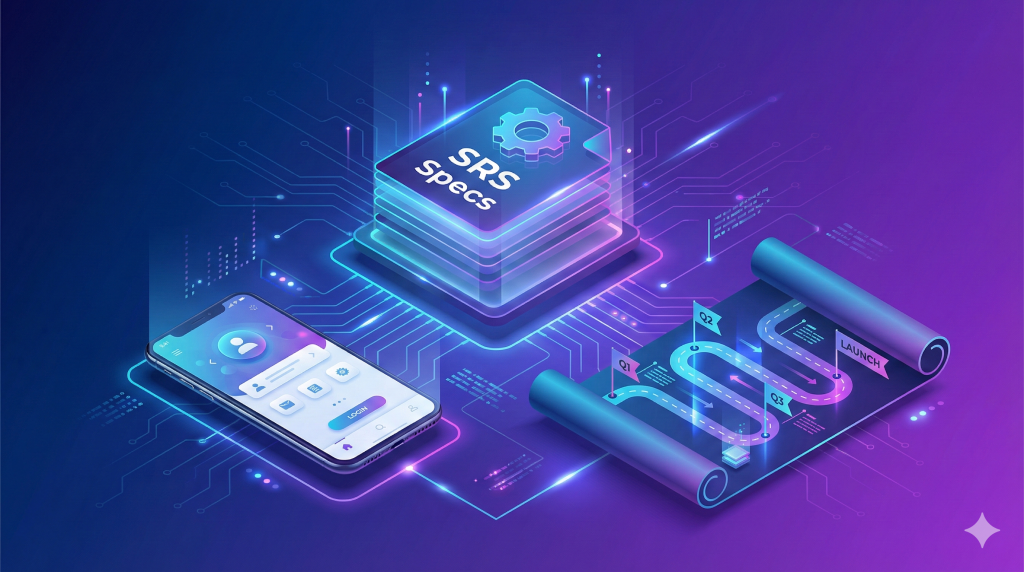
After 4 weeks, you don’t just have a “better understanding,” but a set of artifacts that are your property:
- Software Requirements Specification (SRS): A detailed technical assignment understandable to any development team.
- Interactive UX Prototype: Visualization of the app’s logic.
- Architecture Solution: Description of the technical stack and system structure.
- Project Plan and Budget: Detailed estimate (WBS – Work Breakdown Structure) and Roadmap.
Conclusion
The Discovery Phase is not an expense; it is an investment in predictability. By spending $X on Discovery, you insure yourself against losing $5X on fixing mistakes in the future.
You gain confidence in what you are building, how you are building it, and how much it will realistically cost.
Ready to turn your idea into a clear action plan? Contact us, and let’s discuss how to conduct a Discovery Phase for your mobile product.