
The media content market is booming. Platforms like Audible and Netflix – along with a surge in regional streaming services – are driving businesses to look for reliable ways to launch their own products.
PHP is often overshadowed by Go or Node.js in discussions about streaming backends. But modern PHP (8.1+) combined with the right architecture can handle the high loads and complex pipelines of media platforms.
At VRG Soft, we’ve built numerous media services, and here are five backend decisions you shouldn’t skip when building an audiobook platform or online cinema with PHP.
1. Asynchrony and Queues: Keep Your Servers Cool
A common rookie mistake is processing media files “on the fly” in the same request that serves the user. Upload a 50 MB audiobook chapter and your server can freeze if it’s not designed for async tasks.
The Solution:
- RabbitMQ or Redis Streams with confirmations, retries (backoff), and DLQs.
- Jobs are idempotent and safe for concurrent processing.
- Background workers handle CPU-heavy operations.
Workflow:
- User uploads a file.
- Backend immediately responds: “File accepted”.
- Job enters the queue.
- Worker converts, segments, and uploads the file.
VRG Soft Tip: For real-time features, we use long-lived runtimes like Swoole or RoadRunner via Laravel Octane, carefully preventing state leakage between requests.
2. Storage and Delivery: Beyond One Server
Storing videos on the app server is a recipe for bottlenecks. Disk fills fast, bandwidth collapses during traffic spikes.
The Solution: Hybrid Storage + CDN
- Object Storage: AWS S3, Google Cloud Storage, or MinIO for originals and transcoded assets.
- CDN: Cloudflare, CloudFront, or similar. Users are served from the closest PoP, with properly configured range requests, signed URLs/cookies, cache keys/headers, and strict CORS.
This setup reduces latency, offloads your servers, and scales globally.
3. Transcoding & Adaptive Bitrate (HLS/DASH)
Serving raw 4K MP4s isn’t realistic – users have varying devices and bandwidth.
The Solution:
- Backend orchestrates transcoding via FFmpeg (PHP-wrapped) or AWS MediaConvert.
- Outputs packaged with HLS or MPEG-DASH.
Key Concepts:
- Segments are usually 2–6 seconds for VOD; for low-latency streams, we use LL-HLS.
- Multiple quality levels (360p → 4K) let the player automatically pick the best stream.
- PHP orchestrates the pipeline, validates artifacts, and publishes manifests and segments through the CDN – the packager handles manifest generation.
4. Content Protection & DRM
Piracy is the #1 risk when selling audiobooks or films.
The Solution:
- Signed URLs: Preferably tied to session/device. IP binding is unreliable due to CGNAT and mobile networks.
- DRM: Widevine, FairPlay, or PlayReady. The backend acts as a License Server issuing keys only to authorized clients.
5. Database Layer: Metadata, History & Analytics
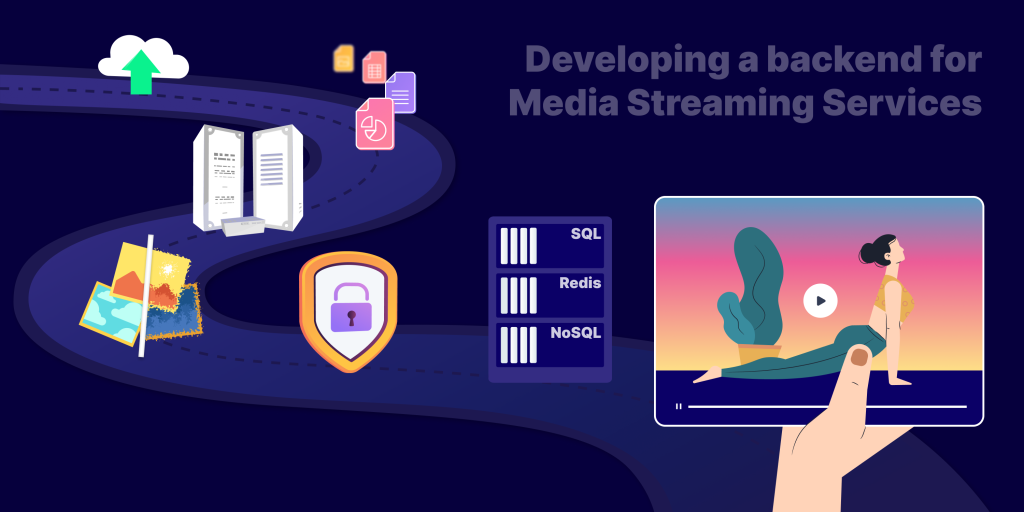
Media platforms aren’t just about files – playback positions, watch history, recommendations, analytics, and subtitles are critical.
The Solution: Multi-Database Strategy
- PostgreSQL: Users, payments, catalogs, relationships.
- Redis: Sessions, hot keys, ephemeral state.
- Search: Elasticsearch/OpenSearch for fast, typo-tolerant queries.
- Logs & Analytics: ClickHouse, BigQuery, or OpenSearch.
- Document Data: MongoDB for naturally document-oriented structures (playlists, metadata), but not for logs by default.

Conclusion
Building a “niche Netflix” or audiobook platform isn’t just about picking a language – it’s about choosing the right architecture.
PHP shines as the orchestrator, managing cloud storage, transcoding pipelines, DRM/license flows, and global delivery.
At VRG Soft, we know how to build media backends that stay stable during blockbuster premieres or bestseller releases.
Got a media startup idea? Let’s discuss how to bring it to life.